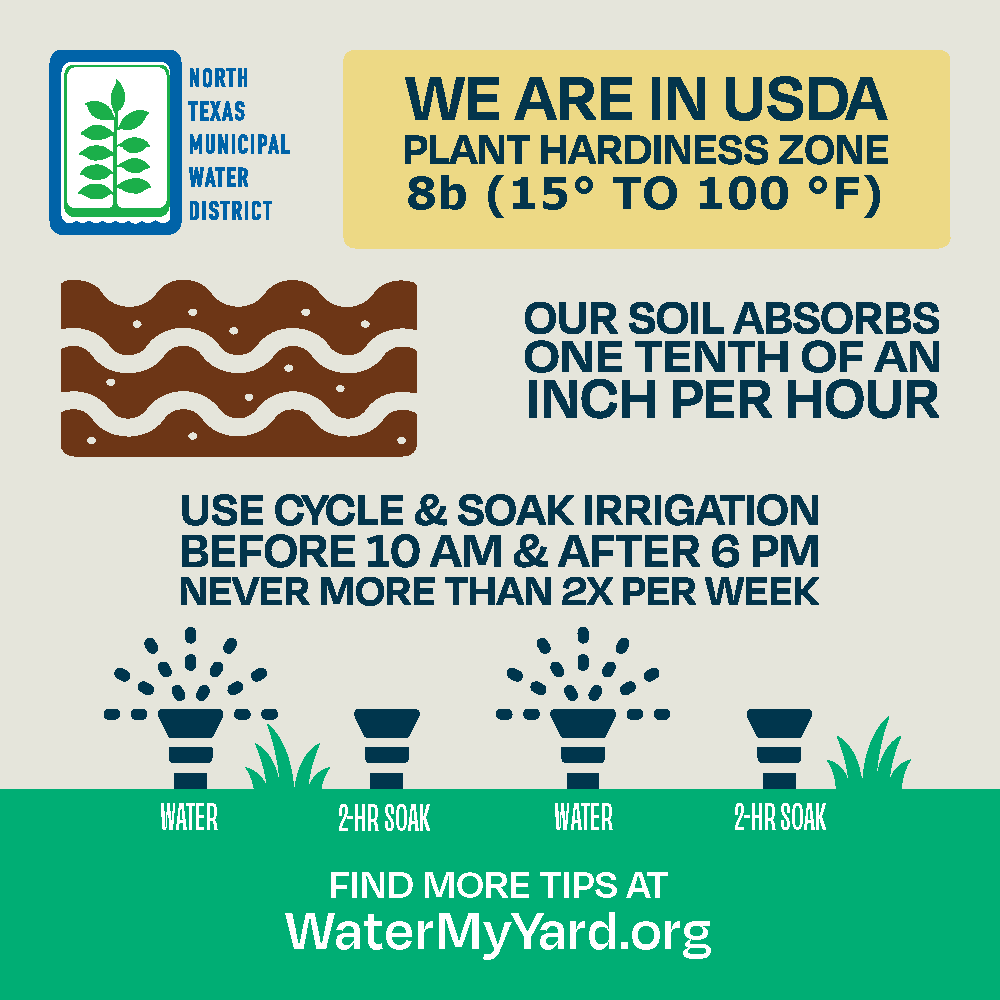
Year-Round Outdoor Watering Schedules
A mandatory weekly watering schedule has gradually gained acceptance in the region and the state. At a minimum, NTMWD requires all Member Cities and Customers to adhere to the permanent outdoor watering schedule listed below. Although the frequency is specified, the schedule is left up to the Member Cities and Customers to designate. Some entities utilize “day of the week” irrigation schedules where watering is based on either even/odd address numbers, trash/recycling pick-up days, or geographic areas related to distribution pressure zones. Please check your water supplier's website for irrigation regulations specific to your location.
- Summer (April 1 – October 31)
- Spray irrigation with sprinklers or irrigation systems at each service address must be limited to no more than two days per week. Additionally, prohibit lawn irrigation watering from 10 a.m. to 6 p.m. Education should be provided that irrigation should only be used when needed, which is often less than twice per week, even in the heat of summer.
- The primary purpose of this measure is to reduce wind drift and evaporation losses during the active growing season. The time-of-day watering schedule requirement increases watering efficiency by eliminating outdoor irrigation use when climatic factors negatively impact irrigation system efficiencies. Midday irrigation is not an optimal time to irrigate because evapotranspiration rates are higher, and plants are more susceptible to stress associated with factors such as higher temperatures and lower relative humidity.
- Winter (November 1 – March 31)
- Spray irrigation with sprinklers or irrigation systems at each service address must be limited to no more than one day per week with education that less than once per week (or not at all) is usually adequate.
Additional irrigation during both schedules may be provided by hand-held hose with a shutoff nozzle, use of dedicated irrigation drip zones, and/or soaker hose provided no runoff occurs.
Why Reduce Your Outdoor Water Use?
Many North Texas horticulturists have endorsed twice-weekly watering as more than sufficient for landscapes in the region, even in the heat of summer. This is due to the thick, sticky clay soils found in North Central Texas. These black and red clays led to our region being known as the Blackland Prairie ecosystem. The clay slowly absorbs the water (about a tenth of an inch per hour), but it doesn't want to let it go once it becomes absorbed. This water retention causes the clay to become highly sticky but also causes water runoff if more water is applied than it can absorb.
During the winter, the clay soil can retain water even longer than in the summer, no longer losing it as quickly to evaporation. A single wet September or October can result in clay so packed full of moisture the plants in our landscapes can hydrate themselves on just the retained soil moisture and the occasional hand watering (if rain is sparse).
According to Texas A&M AgriLife Extension, irrigation is recommended only during the growing season months. Normally irrigation is not necessary during the late fall, winter, or early spring when most turf grasses are dormant, temperatures are cool, or when rainfall is occurring. To know if supplemental irrigation is necessary during the fall or winter months, please sign up at WaterMyYard.org.